
COMFORT Explorer
Connecting Europe's fortified heritage
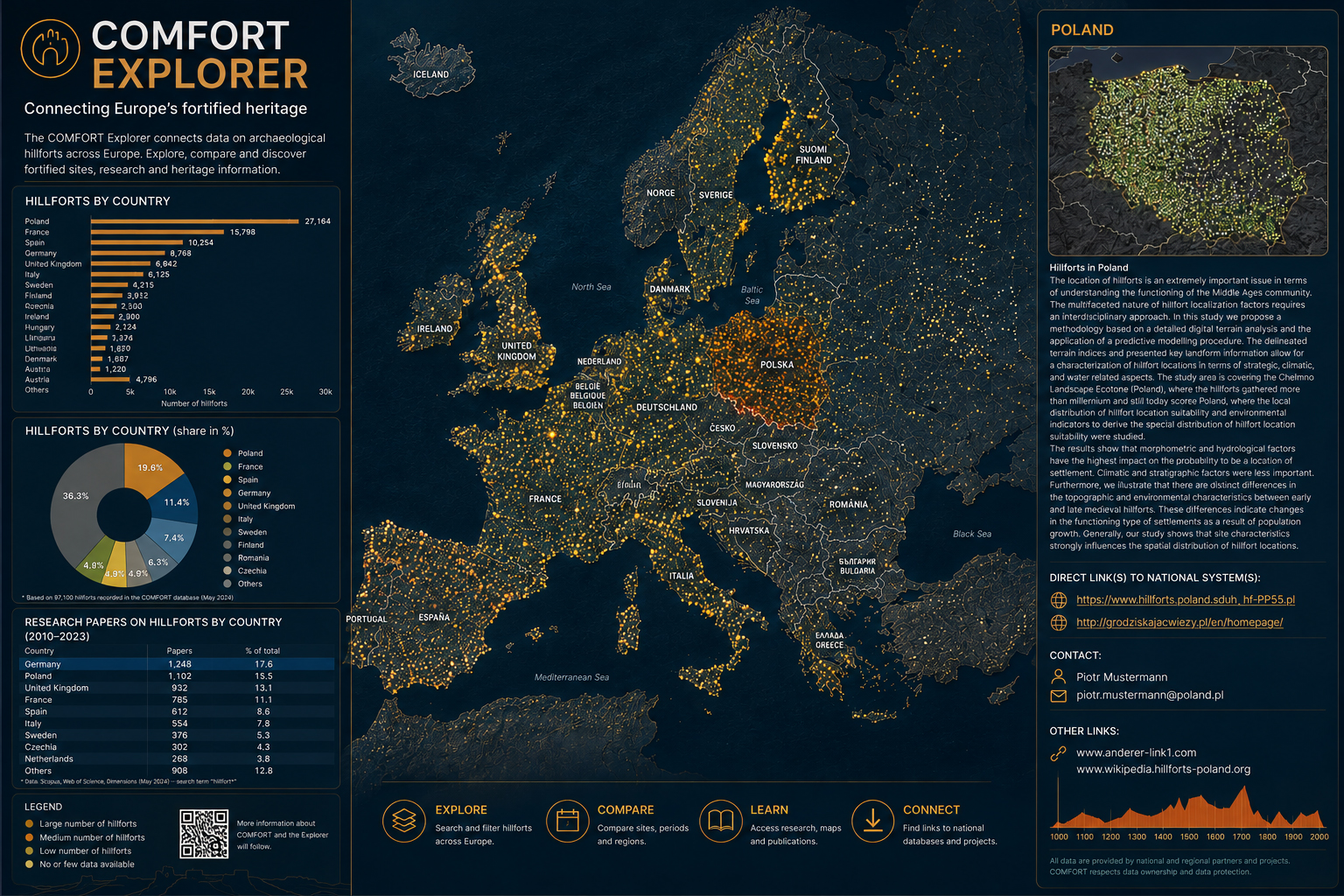
An idea of the capabilites, the planned explorer should have. Spatial filtering and on-the-fly statistics are discussed.
The vision
Across Europe, information on archaeological fortifications is distributed among national and regional databases, research projects, publications, archives and individual datasets. Different terminologies, chronological systems and data structures make it difficult to compare these sites across modern borders.
The COMFORT Explorer aims to change this.
It is conceived as a pan-European digital gateway to archaeological fortifications, connecting existing information rather than replacing established national and regional databases. Through an interactive map and common search environment, users will be able to discover fortified sites across Europe and follow links to the institutions, databases and research projects that provide the underlying information.
The long-term vision is to make archaeological fortification data more findable, accessible, interoperable and reusable (FAIR) while respecting the ownership, provenance and individual character of the contributing datasets.
The Explorer is intended for archaeologists and other researchers, heritage professionals, students and educators, as well as everyone interested in Europe’s fortified cultural heritage. By bringing together information across regions and periods, it will provide new opportunities for comparative research, heritage protection and public engagement.
The initiative builds on the international network of COMFORT and is being developed in connection with our activities towards a shared European research infrastructure for archaeological fortification data.
What will you be able to explore?
The future Explorer is intended to provide access to:
- archaeological fortifications from different regions and periods across Europe;
- geographical location and basic site information;
- chronology, classification and research history;
- links to existing national and regional databases;
- bibliographic and archival resources;
- maps, plans, images and other digital documentation where available;
- interoperable datasets for research and further analysis.
Coming soon
The COMFORT Explorer is currently in development.
The COMFORT Explorer is not yet publicly available. More information on its development, participating datasets and opportunities to contribute will be published here as the project progresses.